
Hua Hin, Thailand
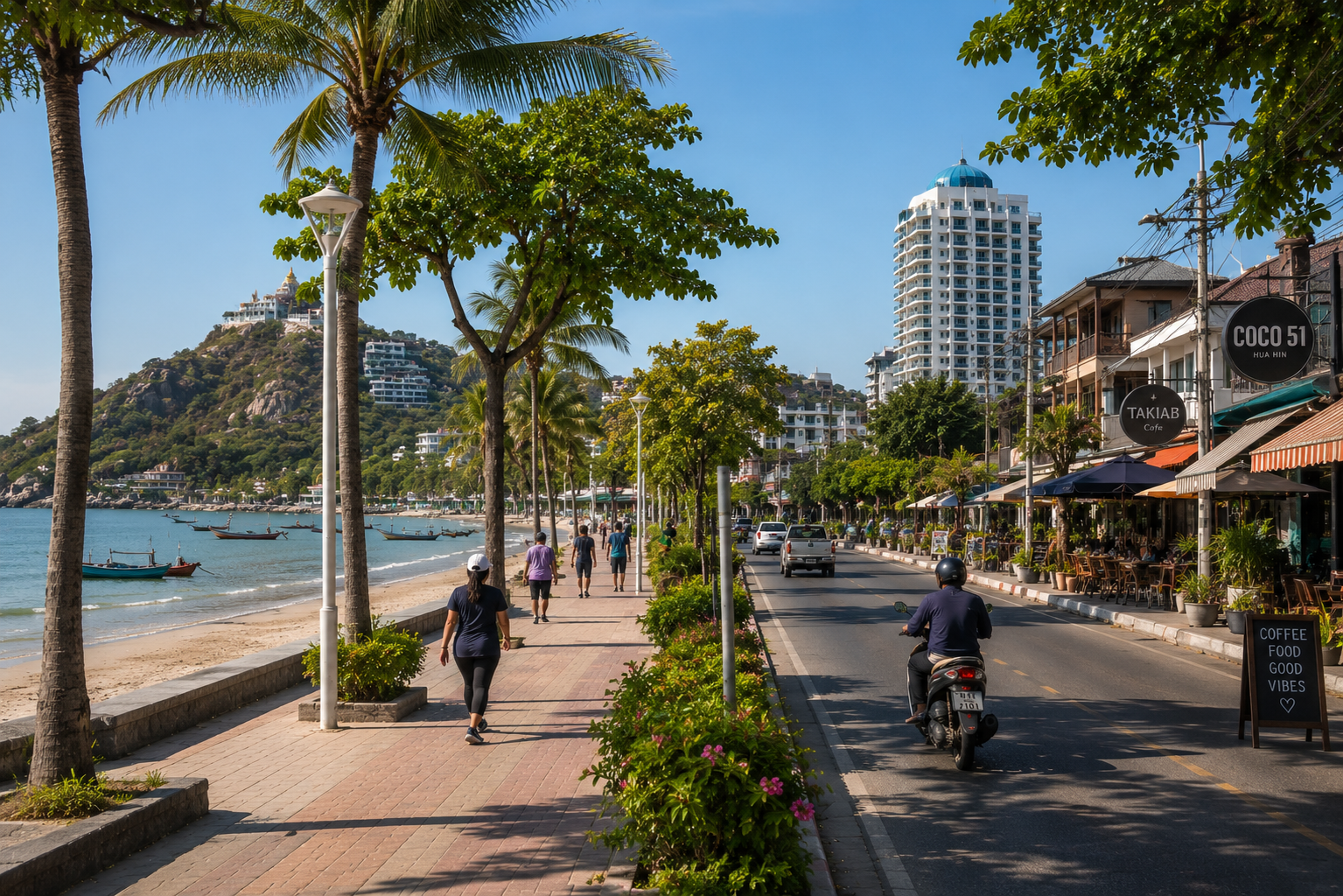
Retire in Hua Hin at a Glance
Hua Hin combines practical retirement costs, healthcare access, expat support, and a lifestyle profile suited to long-term retirement planning.
Best For
- Quiet retirement
- Good healthcare access
- Established expat community
- Long-term retirement living
Monthly Condo Rent
US$400-550
US$550-850
US$900-1400
Monthly Retirement Budget
US$1300-1700
US$1800-2600
US$2800-4200
Key Strengths
Healthcare: Good
Expat Community: Established
Best For: Quiet retirement
Confidence:
Executive Overview
Hua Hin has quietly developed one of the strongest reputations in Thailand for retirees seeking a calmer, more manageable version of tropical coastal living. Unlike Phuket or Pattaya, Hua Hin is not built around heavy tourism intensity or nonstop entertainment. Instead, the city offers a slower and more residential atmosphere that appeals strongly to retirees prioritizing comfort, stability, routine, and lower daily stress.
Originally developed as a royal seaside retreat, Hua Hin still retains a noticeably different character from many of Thailand’s larger coastal destinations. The city feels more orderly, more relaxed, and more retirement-oriented than most major beach destinations in the region.
For retirees seeking warm climate, beach access, manageable infrastructure, and a quieter pace of life, Hua Hin can be deeply appealing. The city combines coastal living, modern conveniences, strong healthcare access, international dining, and established expat infrastructure within an environment that many retirees find emotionally sustainable over long periods of time.
Compared with Bangkok, Hua Hin feels dramatically slower and less stressful. Compared with Pattaya, it feels calmer and less commercially aggressive. Compared with Phuket, it feels more residential, less tourism-driven, and easier to manage operationally.
Hua Hin is not a city built around excitement or stimulation. Its appeal is rooted in comfort, simplicity, predictability, and long-term livability.
Many retirees who settle in Hua Hin eventually realize that the city’s greatest strength is not what it adds to life, but what it removes. Traffic stress, constant stimulation, excessive tourism pressure, and metropolitan intensity are all reduced significantly compared with many other Southeast Asian retirement destinations.
For retirees seeking a lifestyle built around sustainability rather than excitement, Hua Hin can become highly attractive over long retirement timelines.
Quick Snapshot
Cost of Living: Moderate and generally manageable for long-term retirees
Healthcare Quality: Strong regional healthcare with access to respected private hospitals
Lifestyle: Relaxed coastal retirement living with lower daily intensity
Climate: Tropical coastal climate with year-round warmth and seasonal rains
Expat Community: Established, mature, and retirement-oriented
Best For: Retirees seeking calm coastal living, manageable pace, and lower-stress retirement
Lifestyle and Environment
Hua Hin offers a lifestyle built around routine and ease rather than stimulation or spectacle. Daily life tends to move at a slower pace, and many retirees find that the city naturally encourages quieter routines, outdoor activity, café culture, beach walks, and socially relaxed living.
Compared with Bangkok or Phuket, Hua Hin feels significantly less intense. Traffic is lighter, the scale is smaller, and daily errands are generally easier to manage. Many retirees value the fact that they can develop routines without constantly navigating congestion, heavy tourism density, or the sensory overload that often accompanies larger Southeast Asian cities.
One of Hua Hin’s strongest long-term advantages is emotional sustainability. Some retirement destinations feel exciting initially but become tiring over time because of noise, traffic, tourism pressure, or constant activity.
Hua Hin tends to produce the opposite effect. Many retirees gradually become more attached to the city because daily life remains manageable, familiar, and relatively low stress.
The city also has a strong practical side. While Hua Hin is quieter than Bangkok or Phuket, it still offers shopping centers, international restaurants, modern condominiums, private hospitals, golf courses, cafés, and broad expat infrastructure.
That balance between simplicity and convenience is one of the city’s defining strengths.
Many retirees eventually realize that Hua Hin provides enough infrastructure to remain comfortable while still preserving a slower emotional rhythm. That combination is surprisingly rare. Some coastal destinations become too commercialized and chaotic over time, while others become so quiet that retirees eventually feel isolated or operationally limited. Hua Hin often occupies a comfortable middle ground between those extremes.
At the same time, retirees seeking nightlife, major urban stimulation, or highly dynamic social environments may eventually find Hua Hin too quiet or repetitive. The city works best for retirees who genuinely enjoy slower pacing, routine, and stability.
For retirees comfortable with calmness, Hua Hin can feel emotionally restorative in a way that many larger retirement destinations cannot.
Cost of Living
Hua Hin offers relatively good retirement value considering the quality of life available. It is generally more affordable than Phuket and often less expensive than Bangkok, particularly regarding housing and day-to-day lifestyle costs.
The city works well for retirees who want comfort, healthcare access, and coastal living without needing the larger budgets often associated with major resort destinations.
Housing options are broad and varied. Retirees can choose between condominiums, villas, gated communities, or quieter residential homes farther from the city center.
Many retirees are attracted to Hua Hin because the housing market supports a relatively comfortable lifestyle at moderate retirement budgets. Compared with Phuket, retirees often receive more space, quieter surroundings, and lower long-term housing costs.
Neighborhood selection still matters significantly. Some retirees prefer areas closer to the beach, shopping, and restaurants, while others prioritize quieter residential districts, golf communities, or lower-density environments.
Food and dining are strong relative to the city’s size. Hua Hin has Thai restaurants, seafood, cafés, bakeries, and a good range of Western dining options.
Imported groceries and specialty products are available, though not at the depth seen in Bangkok or Kuala Lumpur. However, for many retirees, Hua Hin provides enough international access to remain highly comfortable long term.
Over time, access to familiar foods and reliable international dining becomes increasingly important psychologically. Retirees often discover that maintaining food variety, routine grocery access, and occasional Western comfort foods contributes significantly to emotional sustainability abroad. Hua Hin performs reasonably well in this area while still maintaining a calmer and more local atmosphere than larger metropolitan environments.
Utilities are generally manageable, and internet infrastructure is solid in developed residential areas. Electricity costs can increase because of air-conditioning usage, particularly during hotter months.
One of Hua Hin’s strongest financial advantages is that retirees can maintain comfortable lifestyles without constantly feeling financial pressure. Dining out regularly, hiring occasional household assistance, maintaining active social routines, and enjoying coastal living often remain achievable on moderate retirement budgets.
For retirees focused on long-term financial sustainability rather than luxury consumption, Hua Hin often performs very well.
Healthcare
Healthcare is one of Hua Hin’s strongest practical advantages relative to many smaller coastal retirement destinations.
The city has several respected private healthcare facilities, including Bangkok Hospital Hua Hin, which provides diagnostics, specialist consultations, emergency care, and many common long-term retirement healthcare services.
For routine retirement healthcare needs, Hua Hin generally performs well. Retirees with more complex medical conditions sometimes travel to Bangkok for advanced specialist care, major procedures, or deeper hospital ecosystems, but Bangkok’s relative proximity helps make this manageable.
Compared with many beach-oriented retirement destinations globally, Hua Hin offers stronger healthcare infrastructure than retirees often expect. This contributes significantly to the city’s reputation as a sustainable long-term retirement environment rather than simply a vacation destination.
Many retirees eventually realize that calmness alone is not enough for long-term retirement success. Healthcare access, reliability, and confidence become increasingly important with age, and Hua Hin balances lower-stress living with practical medical accessibility better than many smaller retirement cities.
Compared with Phuket, Hua Hin’s healthcare ecosystem is somewhat smaller overall, but many retirees still feel operationally comfortable because Bangkok remains relatively accessible for higher-level care.
For retirees prioritizing healthcare reassurance while avoiding the stress of larger cities, Hua Hin often provides a strong compromise between medical accessibility and lifestyle calmness.
Healthcare quality also contributes psychologically to long-term retirement comfort. Many retirees report that simply knowing quality care is available nearby significantly improves their overall sense of security and emotional stability abroad.
Visa Options
Thailand’s retirement visa ecosystem is mature and well established, and Hua Hin benefits from Thailand’s decades of experience hosting foreign retirees.
Visa processes can still involve renewals, financial reporting, documentation, and periodic bureaucratic requirements, but retirees generally have access to legal assistance, visa services, and expat-oriented administrative support.
Compared with Vietnam or Indonesia, Thailand often feels more normalized as a retirement destination because of the scale and maturity of its foreign retiree ecosystem.
Many retirees in Hua Hin are long-term residents who have already adapted to the systems and routines required for retirement living in Thailand, which creates a relatively stable and experienced expat environment.
For many retirees, one of Hua Hin’s advantages is that the city feels operationally familiar. Services exist specifically because large numbers of foreign retirees have already lived there successfully for many years.
That ecosystem reduces friction significantly compared with destinations where retirees constantly feel like outsiders navigating unfamiliar systems without support structures.
Infrastructure and Accessibility
Hua Hin’s infrastructure is practical and manageable rather than large-scale or highly sophisticated.
The city offers shopping centers, hospitals, restaurants, cafés, local markets, golf courses, and transportation connections without the overwhelming scale of Bangkok.
One of Hua Hin’s strongest operational advantages is that the city is relatively easy to navigate. Many retirees can structure their lives in ways that minimize traffic, long travel times, and urban stress.
Compared with Pattaya or Phuket, Hua Hin often feels more relaxed, less congested, and more retirement-oriented.
Transportation options include taxis, ride-hailing, local transport, private vehicles, and rail connections to Bangkok.
The city does not offer large-scale rail transit systems like Bangkok, but its smaller scale makes daily transportation simpler overall.
Hua Hin’s strongest infrastructure strengths include manageable scale, practical convenience, healthcare access, and lower operational stress.
Its main limitations are smaller infrastructure depth, less nightlife and entertainment, and fewer international options compared with Bangkok or Phuket.
Some retirees eventually feel the city lacks stimulation, variety, or metropolitan energy. Others experience the opposite reaction and increasingly value the city’s simplicity as they age.
One of Hua Hin’s most important long-term strengths is that retirees can often maintain routines with relatively low operational complexity. That simplicity frequently becomes more valuable over time than access to endless entertainment or large-scale urban infrastructure.
Neighborhoods and Housing
Central Hua Hin
Offers the strongest access to restaurants, shopping, beaches, and daily conveniences.
Popular among retirees who prioritize walkability, convenience, and easy access to services.
Khao Takiab
A quieter area south of central Hua Hin known for beach access, condominiums, cafés, and calmer atmosphere.
Many retirees seeking a slower and more residential coastal environment prefer this district.
Hin Lek Fai
More residential and inland, often preferred by retirees seeking villas, quieter neighborhoods, and lower-density living.
The area appeals strongly to retirees prioritizing privacy and space.
Black Mountain Area
Popular among retirees interested in golf communities, larger homes, and more resort-style residential environments.
Housing in Hua Hin varies significantly depending on distance from the beach, neighborhood maturity, flood exposure, and infrastructure quality. Retirees who spend time understanding local geography and seasonal conditions generally experience much higher long-term satisfaction.
Transportation
Transportation in Hua Hin includes taxis, songthaews, ride-hailing, private vehicles, and rail access to Bangkok.
Many retirees appreciate that daily transportation is generally simpler, shorter, and less stressful than in larger Thai cities.
One of Hua Hin’s practical advantages is that retirees can often organize their lifestyles around proximity, routine, and neighborhood familiarity, which reduces transportation dependence significantly.
Compared with Bangkok, operational movement through the city feels dramatically easier. Compared with Phuket, Hua Hin often feels less chaotic and less heavily tourism-driven.
The city’s smaller scale allows retirees to build highly manageable routines centered around healthcare, shopping, cafés, beaches, and social environments without requiring constant travel.
For many retirees, this lower transportation stress becomes increasingly valuable with age.
Safety
Hua Hin is generally viewed as one of Thailand’s calmer and more comfortable retirement environments from a safety perspective.
The city has a relatively relaxed atmosphere, and many retirees report feeling comfortable, secure, and operationally at ease after settling into daily routines.
Normal precautions still apply regarding road safety, petty theft, and awareness in tourist areas, but Hua Hin generally lacks much of the nightlife intensity, congestion, and heavy tourism pressure seen in larger coastal destinations.
Many retirees describe the city as emotionally calmer and less aggressive than Pattaya or Phuket. Streets often feel quieter, neighborhoods feel more residential, and the overall pace of life contributes strongly to feelings of comfort and security.
For retirees prioritizing lower stress and emotional manageability, Hua Hin performs strongly in this category.
Climate and Environment
Hua Hin has a tropical coastal climate with year-round warmth, humidity, sea breezes, and seasonal rainfall.
Compared with Bangkok, Hua Hin often feels less dense, more open, and environmentally calmer.
Compared with Phuket, the climate is somewhat less dramatic and less island-oriented, though still distinctly tropical.
Many retirees enjoy Hua Hin because the climate supports outdoor living, walking, golf, beach routines, and café-oriented social lifestyles.
At the same time, retirees should understand that tropical retirement living still involves persistent humidity, heat, and rainy-season adjustments.
Long-term comfort often depends on housing quality, lifestyle routines, and heat tolerance.
One of Hua Hin’s strongest environmental advantages is that the city remains physically manageable. Many retirees spend substantial time outdoors because daily routines naturally integrate beaches, cafés, walking, and low-stress movement patterns.
For retirees seeking tropical living without the overwhelming density of larger coastal cities, Hua Hin often feels highly balanced.
Expat Community
Hua Hin has a mature and retirement-oriented expat community.
Compared with Phuket or Pattaya, Hua Hin’s foreign resident population often feels older, calmer, and more stability-focused.
Retirees can find social clubs, golf groups, hobby communities, cafés, churches, and established expat networks relatively easily.
One of Hua Hin’s strengths is that the social environment often feels less transient and less tourism-driven than larger resort destinations.
For retirees seeking social accessibility without excessive nightlife or tourism intensity, Hua Hin performs particularly well.
Many retirees describe the social atmosphere as more grounded and sustainable long term. Relationships often revolve around routine, hobbies, cafés, golf, and recurring neighborhood interaction rather than highly transient tourism activity.
For retirees who value emotional familiarity and recurring community structures, Hua Hin can feel highly comfortable over time.
Advantages of Retiring in Hua Hin
Calm Lifestyle
Hua Hin offers one of Thailand’s more relaxed and emotionally sustainable retirement environments.
Coastal Living
Beach access and tropical outdoor living remain major lifestyle strengths.
Manageability
The city’s scale reduces stress, congestion, and operational complexity.
Healthcare Access
Private healthcare is strong relative to the city’s size and retirement focus.
Emotional Sustainability
Many retirees find Hua Hin easier to maintain emotionally over long retirement timelines than more stimulation-heavy destinations.
Challenges of Retiring in Hua Hin
Slower Pace
Some retirees eventually find Hua Hin too quiet, repetitive, or lacking stimulation.
Infrastructure Depth
The city does not offer the same healthcare scale, shopping variety, or metropolitan infrastructure as Bangkok.
Climate
Humidity and heat remain constant realities of tropical retirement living.
Limited Metropolitan Energy
Retirees seeking highly dynamic urban environments may eventually feel constrained by the city’s smaller scale and slower rhythm.
Who This City Is Best For
Strong Matches
- Calm-lifestyle retirees
- Coastal retirees
- Golf-oriented retirees
- Lower-stress retirees
- Routine-oriented retirees
Less Suitable Matches
- Urban-energy retirees
- Nightlife-focused retirees
- Highly stimulation-oriented retirees
- Retirees seeking large-city infrastructure depth
Comparison With Other Cities
Hua Hin vs Phuket
Hua Hin is calmer, more residential, and less tourism-intense. Phuket offers stronger international infrastructure, greater lifestyle activity, and more resort-style living.
Retirees seeking lower stress and more emotionally sustainable routines often prefer Hua Hin despite Phuket’s larger infrastructure ecosystem.
Hua Hin vs Pattaya
Hua Hin feels quieter, more retirement-oriented, and less commercially aggressive.
Pattaya offers greater convenience, larger expat infrastructure, and more active social environments.
This comparison often comes down to whether a retiree values calmness or stimulation more strongly.
Hua Hin vs Chiang Mai
Chiang Mai offers cooler seasons, mountain atmosphere, and stronger cultural immersion.
Hua Hin offers beach living, coastal climate, and stronger tropical outdoor lifestyle integration.
Retirees prioritizing beaches and warmer coastal routines often prefer Hua Hin, while retirees seeking cooler weather and inland calmness may prefer Chiang Mai.
Hua Hin vs Penang
Penang offers stronger healthcare depth, more sophisticated infrastructure, and broader international integration.
Hua Hin offers a slower, calmer, and often emotionally softer retirement atmosphere.
Retirees prioritizing operational convenience may prefer Penang. Retirees prioritizing emotional simplicity and lower stress may strongly prefer Hua Hin.
Final Assessment
Hua Hin remains one of Thailand’s strongest retirement destinations for retirees seeking calmness, simplicity, coastal living, and lower long-term stress.
Its greatest strength is not excitement or infrastructure scale. It is emotional sustainability.
The city offers a version of retirement living that many retirees find highly manageable over five-, ten-, or twenty-year timelines.
For retirees seeking warm climate, practical comfort, beach access, and a slower but still connected retirement environment, Hua Hin remains one of Southeast Asia’s most balanced long-term retirement cities.
The city succeeds because it reduces friction. Daily life often feels calmer, more predictable, and emotionally lighter than in many larger or more tourism-intensive retirement destinations.
For retirees seeking a sustainable tropical retirement lifestyle built around routine, comfort, and manageable living, Hua Hin remains one of the region’s strongest long-term options.
Find Your Best Retirement Destination
Use the retirement questionnaire to compare destinations based on your own retirement priorities, preferences, and long-term retirement goals.