
Hoi An, Vietnam
Retire in Hoi An at a Glance
Hoi An combines practical retirement costs, healthcare access, expat support, and a lifestyle profile suited to long-term retirement planning.
Best For
- Charm, lifestyle
- Limited healthcare access
- Small expat community
- Long-term retirement living
Monthly Condo Rent
US$300-450
US$450-700
US$800-1300
Monthly Retirement Budget
US$1000-1400
US$1500-2200
US$2500-3800
Key Strengths
Healthcare: Limited
Expat Community: Small
Best For: Charm, lifestyle
Confidence: Medium
Executive Overview
Hoi An offers one of Southeast Asia’s most emotionally calming and visually distinctive retirement environments. Located on Vietnam’s central coast near Da Nang, the city combines historic architecture, slower daily rhythms, café culture, nearby beaches, and highly walkable neighborhoods into a retirement setting that feels fundamentally different from the region’s larger urban centers.
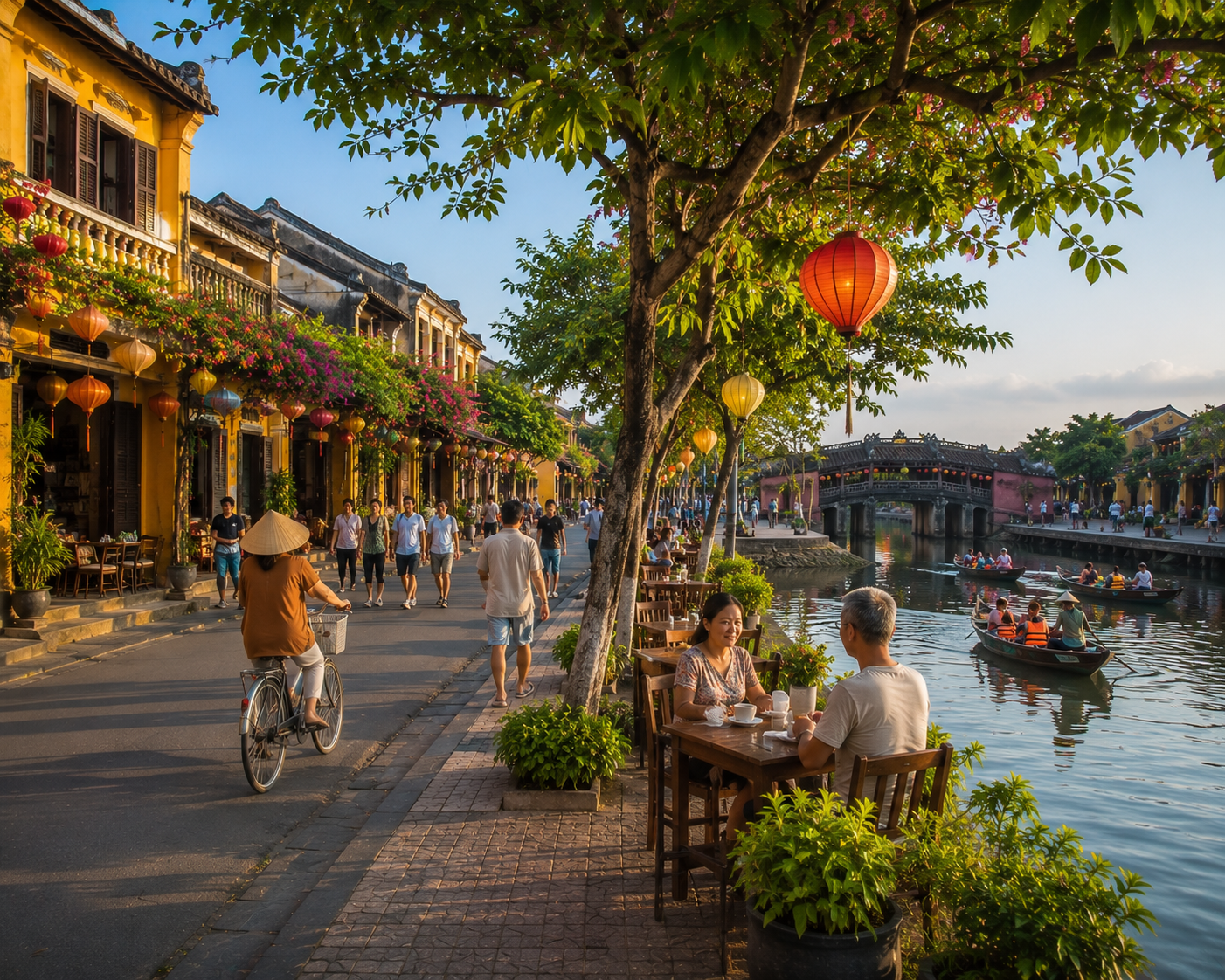
Unlike Bangkok, Ho Chi Minh City, or Manila, Hoi An is not built around metropolitan energy or large-scale infrastructure. Its appeal comes from atmosphere, simplicity, beauty, and pace. For many retirees, daily life there feels softer and more manageable. The city encourages routines built around walking, cafés, riverside dining, bicycle transport, local markets, and neighborhood familiarity rather than traffic, congestion, and constant stimulation.
Compared with Da Nang, Hoi An feels quieter, more intimate, and more emotionally grounded. Compared with Chiang Mai, it feels more tropical and coastal while maintaining a similarly relaxed lifestyle rhythm. Compared with Phuket, it is less commercialized, less internationally polished, and more culturally immersive.
At the same time, retirees should understand that Hoi An is not a fully developed retirement infrastructure city. Healthcare depth is limited locally, tourism influences the economy and atmosphere, and infrastructure sophistication remains below the level found in Thailand or Malaysia. Long-term retirement success in Hoi An depends heavily on lifestyle expectations, healthcare needs, and personality fit.
Retirees seeking slower living, emotional calmness, cultural atmosphere, and manageable daily routines often find Hoi An deeply rewarding over long retirement timelines.
Quick Snapshot
Cost of Living: Affordable relative to most established retirement destinations
Healthcare Quality: Limited locally, with stronger care available in nearby Da Nang
Lifestyle: Slow-paced cultural and coastal living with strong walkability
Climate: Tropical monsoon climate with warm temperatures and rainy seasons
Expat Community: Small but established and socially connected
Best For: Slow-lifestyle retirees, culturally oriented retirees, and retirees seeking calm coastal living
Lifestyle and Environment
Hoi An’s defining characteristic is pace. The city moves noticeably slower than most Southeast Asian urban environments, and many retirees discover that this becomes one of its greatest long-term strengths.
Daily life often revolves around simple and highly repeatable routines. Many retirees naturally settle into patterns built around morning walks, cafés, riverside dining, cycling, beach visits, and neighborhood social interaction.
Unlike heavily commercialized retirement hubs, Hoi An still feels relatively human-scaled and emotionally accessible. Retirees can establish routines quickly, recognize familiar faces, and develop a sense of place that many larger cities struggle to provide.
The city’s historic core contributes heavily to its emotional identity. Lantern-lit streets, preserved architecture, riverside cafés, and pedestrian-oriented areas create an atmosphere that many retirees describe as calming and restorative. In many retirement destinations, retirees eventually become fatigued by traffic, stimulation, or urban intensity. Hoi An often produces the opposite effect. Many long-term residents become increasingly attached to the city because life there remains emotionally manageable.
At the same time, Hoi An is also a major tourism destination, and retirees should understand that tourism is part of the city’s long-term reality. Certain sections of the Old Town become crowded during peak seasons, and the economy is closely tied to international visitors. However, retirees who live outside the busiest tourism zones often experience a much quieter and more residential version of Hoi An than short-term visitors ever see.
The city works best for retirees who genuinely value slower pacing, lower stimulation, and emotional quality of life more than large-scale convenience or infrastructure sophistication.
Retirees seeking nightlife, constant activity, or major metropolitan energy may eventually find Hoi An too quiet or limited.
One of Hoi An’s strongest retirement advantages is psychological sustainability. Many retirees eventually discover that lower stimulation and calmer routines become more valuable over time than constant entertainment or large-scale urban activity. Hoi An supports that transition naturally.
The city encourages retirees to slow down rather than constantly optimize movement and productivity. For many long-term residents, that becomes one of the most meaningful aspects of life there.
Cost of Living
Hoi An remains relatively affordable compared with many established retirement destinations globally and across Southeast Asia. Retirees can often maintain comfortable housing, active social routines, café lifestyles, domestic support, and regular dining without requiring extremely large retirement budgets.
Housing costs vary significantly depending on proximity to the Old Town, beach access, and neighborhood popularity among foreigners.
Many retirees prefer areas such as Cam An, Cam Chau, and An Bang because these neighborhoods balance quieter living, café access, beach proximity, and manageable daily convenience.
Compared with Da Nang, Hoi An generally offers a more intimate and lower-intensity lifestyle, though housing inventory is smaller and less modern overall. Retirees looking for luxury condominium infrastructure or highly polished residential systems may eventually prefer larger cities.
Food is one of Hoi An’s strongest lifestyle categories. Vietnamese cuisine is deeply integrated into everyday life, and the city offers excellent access to local cafés, fresh seafood, noodle dishes, bakeries, and neighborhood restaurants.
The international dining scene has also grown steadily because of tourism and long-term foreign residents. Retirees can increasingly access Western cafés, vegetarian restaurants, imported groceries, wines, cheeses, and familiar comfort foods.
Over long retirement timelines, this becomes more important than many retirees initially realize. Emotional sustainability abroad is often shaped not only by affordability and scenery but also by routine comfort and familiarity. Access to reliable cafés, familiar foods, and socially comfortable gathering spaces often becomes psychologically important after many years overseas.
Hoi An performs surprisingly well in this area relative to its size.
Utilities and internet service are generally affordable, though infrastructure consistency still depends heavily on property quality and neighborhood selection.
One of the city’s strongest long-term financial advantages is that retirees can maintain highly active lifestyles without large spending requirements. Many retirees naturally spend less because entertainment and social life revolve around simple and repeatable routines rather than high-cost consumption patterns.
Healthcare
Healthcare is one of Hoi An’s most important long-term retirement considerations and should be evaluated realistically.
The city itself has clinics, local hospitals, and basic medical facilities, but retirees requiring advanced diagnostics, specialist care, major procedures, or complex long-term medical management typically rely on nearby Da Nang, which is approximately 30 to 45 minutes away depending on location and traffic.
Da Nang’s healthcare system has improved substantially in recent years and now provides private hospitals, international clinics, and stronger specialist access than many retirees initially expect. This relationship with Da Nang significantly improves Hoi An’s long-term viability as a retirement destination.
However, retirees with serious medical conditions or strong specialist dependence should carefully evaluate whether relying on another city for major healthcare feels operationally comfortable long term.
Compared with Thailand or Malaysia, Vietnam’s healthcare ecosystem remains less internationally mature overall. Retirees prioritizing healthcare depth above lifestyle atmosphere may eventually prefer Bangkok, Penang, or Kuala Lumpur.
For retirees with moderate healthcare needs and realistic expectations, however, Hoi An’s balance between quality of life and acceptable regional healthcare access can still work very well.
Healthcare decisions in Hoi An are therefore closely connected to lifestyle priorities. Many retirees willingly accept more limited healthcare depth because the city’s emotional quality of life is unusually strong.
Others may eventually conclude that healthcare accessibility should outweigh lifestyle atmosphere as they age. This is one of the most important long-term retirement calculations associated with Hoi An.
Visa Options
Vietnam’s long-term residency and visa systems remain less retirement-focused than Thailand or Malaysia. Administrative procedures can evolve over time, and retirees should expect renewals, paperwork, and some uncertainty regarding long-term residency structures.
For some retirees, this is an acceptable trade-off because affordability, atmosphere, and overall lifestyle quality remain highly attractive.
Others may prefer countries with more mature retirement-oriented visa ecosystems and greater administrative predictability.
Retirees considering Hoi An should approach Vietnam with flexibility, patience, and realistic expectations regarding bureaucracy and long-term administrative consistency.
Many long-term residents accept that part of living in Vietnam involves ongoing procedural adaptation. Retirees who require absolute predictability and highly formalized systems may eventually feel more comfortable elsewhere.
At the same time, retirees who remain adaptable often find that the quality of daily life outweighs many of the frustrations associated with administrative uncertainty.
Infrastructure and Accessibility
Hoi An’s infrastructure is intentionally smaller-scale and lower intensity than major urban environments. This is part of the city’s appeal.
Daily life often feels walkable, bicycle-oriented, neighborhood-based, and emotionally manageable.
Many retirees appreciate that they can structure routines around cafés, markets, beach access, and local restaurants without spending significant time navigating congestion or transportation stress.
At the same time, retirees should understand that Hoi An does not provide large-scale shopping systems, advanced transportation infrastructure, or extensive metropolitan convenience.
Many long-term residents make regular trips to Da Nang for hospitals, airport access, major shopping, and broader services.
This relationship between Hoi An and Da Nang is important. Hoi An works partly because retirees can enjoy slower daily living while still maintaining access to a larger nearby city when necessary.
Compared with Bangkok or Kuala Lumpur, infrastructure sophistication is clearly lower. Compared with many smaller retirement towns globally, however, Hoi An still functions relatively well operationally because tourism has supported cafés, restaurants, internet infrastructure, and foreigner-oriented services.
The city’s operational simplicity becomes increasingly valuable to many retirees over time. Life often feels physically smaller, easier to navigate, and emotionally lighter than in larger urban environments.
Retirees who need constant variety or extensive infrastructure systems may eventually feel constrained. Retirees seeking simplification often experience the opposite reaction and become increasingly attached to the city’s manageable scale.
Neighborhoods and Housing
Cam An
One of Hoi An’s strongest retirement areas because of its combination of beach access, cafés, quieter atmosphere, and strong foreign resident presence.
Many retirees seeking calmer coastal living gravitate toward this district because it offers a highly livable balance between beach access and daily convenience.
Cam Chau
Popular among retirees who want walkability, riverside atmosphere, café access, and proximity to the Old Town without living directly inside tourism-heavy zones.
The area supports highly manageable daily routines and remains one of the city’s more emotionally balanced neighborhoods.
An Bang
Beach-oriented neighborhood known for relaxed atmosphere, tropical lifestyle, and social café culture.
An Bang appeals strongly to retirees prioritizing coastal routines, slower living, and community-oriented social environments.
Old Town Area
Highly atmospheric and culturally immersive, though some retirees eventually prefer quieter residential areas because of tourism density and foot traffic.
Many retirees enjoy spending time in the Old Town while choosing to live slightly outside the busiest areas.
Housing quality in Hoi An varies significantly depending on construction standards, flood exposure, maintenance quality, and neighborhood location. Retirees who carefully evaluate properties and seasonal environmental conditions generally experience much higher long-term comfort.
Transportation
Transportation in Hoi An revolves primarily around walking, bicycles, scooters, taxis, and Grab ride-hailing.
One of the city’s strongest long-term retirement advantages is that transportation stress is dramatically lower than in Bangkok, Ho Chi Minh City, Manila, or Jakarta.
Many retirees organize life around highly localized routines, which reduces operational fatigue significantly over time.
For retirees seeking simplicity and lower daily stress, this becomes an important quality-of-life advantage.
Walking and cycling are deeply integrated into the city’s rhythm. Many retirees spend years in Hoi An without feeling strong pressure to own vehicles or navigate highly stressful transportation systems.
Compared with major Asian metropolitan environments, this can feel psychologically liberating.
At the same time, retirees should understand that transportation simplicity also reflects smaller-scale infrastructure. Those seeking major public transportation systems or highly sophisticated urban convenience may eventually feel operationally limited.
Safety
Hoi An is generally viewed as one of Vietnam’s calmer and more comfortable environments for long-term foreign residents.
Violent crime rates are relatively low, and many retirees report feeling safe, relaxed, and socially comfortable after adapting to local routines and traffic patterns.
The city’s smaller scale contributes heavily to this feeling. Compared with major metropolitan environments, Hoi An generally feels less aggressive, less chaotic, and emotionally softer.
Normal precautions still apply regarding petty theft, scams, and road safety, but overall Hoi An tends to feel relatively manageable operationally.
Many retirees report that the city’s emotional calmness contributes strongly to their sense of safety. Streets feel socially active without becoming overwhelmingly intense, and many neighborhoods develop recurring familiarity over time.
For retirees coming from dense metropolitan environments, this softer emotional atmosphere often becomes one of the city’s strongest long-term attractions.
Climate and Environment
Hoi An has a tropical monsoon climate with year-round warmth, humidity, rainy seasons, and occasional typhoon exposure.
The coastal setting contributes strongly to the city’s emotional appeal. Many retirees integrate beach walks, cycling, cafés, and outdoor social routines into everyday life.
Compared with Hanoi, Hoi An feels warmer, more tropical, and more beach-oriented. Compared with Da Nang, it feels smaller, quieter, and more environmentally intimate.
Flooding can occur during heavy rainy periods, and retirees should understand that seasonal weather patterns are part of long-term life in central Vietnam. However, many retirees still find the climate highly appealing because it supports outdoor living, slower routines, and a strong connection between lifestyle and environment.
One of Hoi An’s strongest environmental advantages is that daily life remains highly connected to outdoor spaces. Many retirees naturally spend significant time outside because the city’s scale and rhythm support walking, cycling, and open-air social routines.
This creates a retirement atmosphere that often feels emotionally healthier and less enclosed than heavily urbanized environments.
Expat Community
Hoi An has a relatively small but socially connected expat community.
Compared with Bangkok, Phuket, or Pattaya, the foreign resident ecosystem is less commercialized, less nightlife-oriented, and more lifestyle-focused.
Many retirees and long-term residents are drawn to Hoi An because of calmness, creativity, café culture, slower living, and emotional atmosphere.
The social environment often feels more intimate and relationship-oriented than in larger retirement destinations. Many retirees find it easier to build recurring social routines, café familiarity, and community connections than in highly transient metropolitan environments.
At the same time, retirees seeking large social scenes, highly active nightlife, or extensive expat infrastructure may eventually find Hoi An socially limited.
The city tends to attract retirees who value quality of relationships over quantity of social activity. Long-term residents often become deeply embedded in neighborhood routines and smaller recurring communities rather than constantly expanding social circles.
For many retirees, this creates a much stronger sense of belonging than they experienced in larger and more anonymous retirement environments.
Advantages of Retiring in Hoi An
Atmosphere
Hoi An offers one of Southeast Asia’s most emotionally calming and visually beautiful retirement environments.
Slow Lifestyle
The city strongly supports lower stress, walkability, routine, and manageable living.
Affordability
Long-term living costs remain relatively moderate relative to quality of life.
Café and Food Culture
Daily life integrates naturally with cafés, markets, local food, and socially relaxed routines.
Emotional Sustainability
Many retirees find that Hoi An supports emotionally balanced and psychologically sustainable long-term living.
Challenges of Retiring in Hoi An
Healthcare Limitations
Advanced medical care typically requires travel to Da Nang.
Infrastructure Depth
The city lacks large-scale metropolitan infrastructure and convenience systems.
Tourism Cycles
Seasonal tourism affects crowd levels, atmosphere, and pricing in certain districts.
Climate
Humidity, storms, and flooding risk are important long-term environmental considerations.
Lifestyle Limitations
Retirees seeking highly active metropolitan environments or constant stimulation may eventually feel constrained.
Who This City Is Best For
Strong Matches
- Slow-lifestyle retirees
- Café-culture retirees
- Coastal retirees
- Lower-stress retirees
- Culturally oriented retirees
Less Suitable Matches
- Retirees requiring advanced healthcare access
- Highly urban retirees
- Nightlife-oriented retirees
- Retirees seeking major infrastructure depth
Comparison With Other Cities
Hoi An vs Da Nang
Da Nang offers stronger infrastructure, deeper healthcare, and more metropolitan convenience.
Hoi An offers slower living, stronger atmosphere, and greater emotional calmness.
Many retirees view the two cities as complementary rather than directly competitive because Hoi An benefits operationally from Da Nang’s nearby infrastructure.
Hoi An vs Chiang Mai
Both support slower retirement lifestyles, café culture, and emotionally sustainable routines.
Hoi An offers coastal living and tropical beach integration, while Chiang Mai offers cooler seasons and mountain atmosphere.
Retirees seeking beaches and tropical softness may prefer Hoi An. Retirees preferring inland calmness and cooler seasonal variation may prefer Chiang Mai.
Hoi An vs Phuket
Phuket offers stronger international infrastructure, larger expat systems, and deeper healthcare.
Hoi An feels calmer, more intimate, less commercialized, and more culturally grounded.
Retirees seeking lower stimulation and stronger emotional calmness often prefer Hoi An despite Phuket’s operational advantages.
Hoi An vs Bali
Both destinations appeal strongly to retirees prioritizing atmosphere and emotional quality of life.
Hoi An generally feels smaller, calmer, and operationally simpler. Bali offers broader international infrastructure, larger expat ecosystems, and greater lifestyle diversity but often with significantly more congestion and tourism intensity.
Final Assessment
Hoi An is one of Southeast Asia’s strongest retirement destinations for retirees seeking calmness, slower living, emotional sustainability, and strong cultural atmosphere.
Its appeal is not built around nightlife, luxury infrastructure, or metropolitan stimulation.
Instead, the city offers beauty, walkability, café culture, coastal living, and highly manageable daily rhythms inside one of Vietnam’s most visually distinctive environments.
Hoi An rewards retirees who value simplicity, adapt comfortably to smaller-scale living, and prioritize emotional quality of life over infrastructure sophistication.
For retirees seeking slower tropical living with strong atmosphere and long-term emotional sustainability, Hoi An remains one of Asia’s most compelling retirement environments.
Its greatest strength is not efficiency or infrastructure. Its greatest strength is that many retirees eventually feel calmer, lighter, and more emotionally balanced living there.
Find Your Best Retirement Destination
Use the retirement questionnaire to compare destinations based on your own retirement priorities, preferences, and long-term retirement goals.