
Jakarta, Indonesia
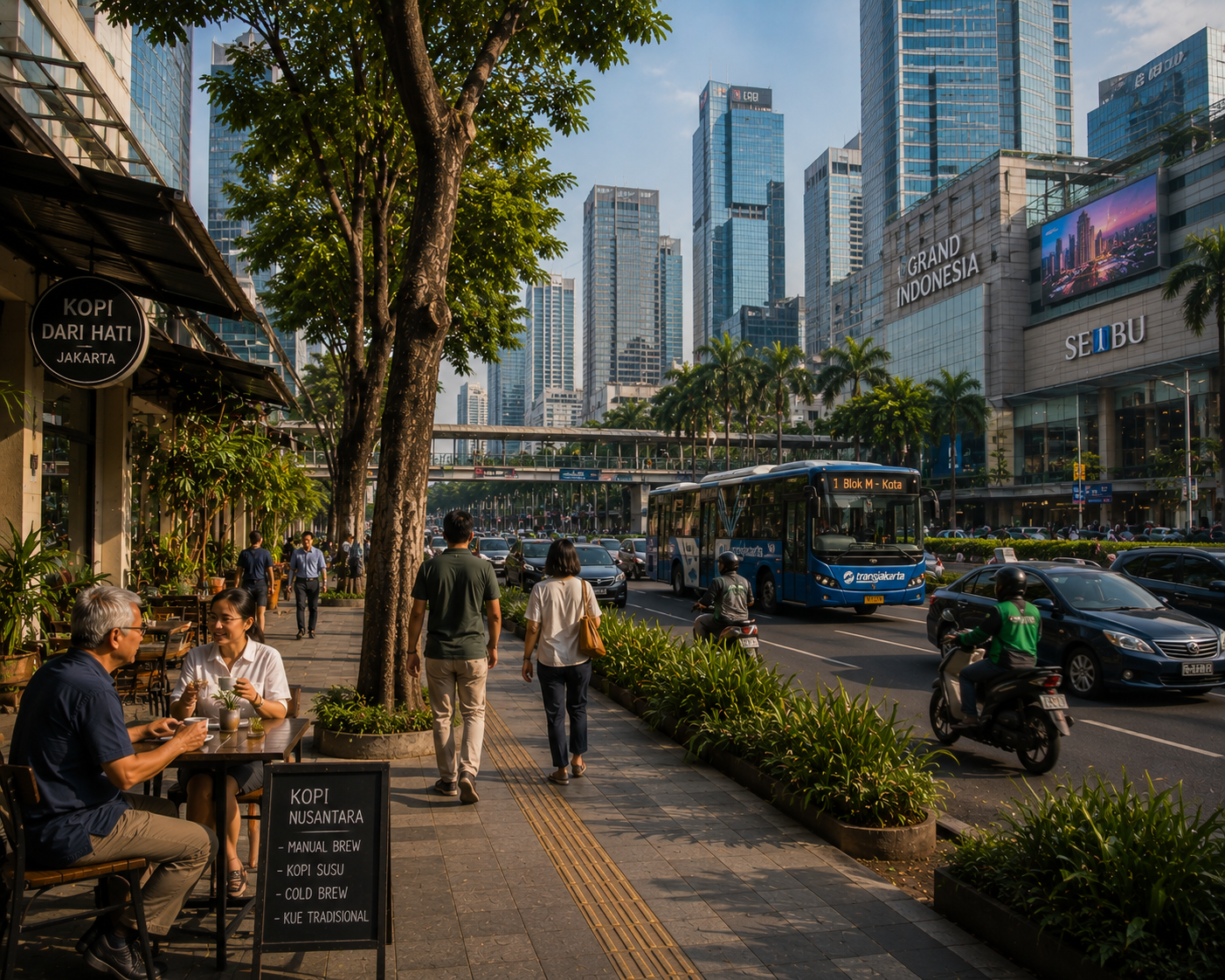
Retire in Jakarta at a Glance
Jakarta combines practical retirement costs, healthcare access, expat support, and a lifestyle profile suited to long-term retirement planning.
Best For
- Urban living
- Strong healthcare access
- Large expat community
- Long-term retirement living
Monthly Condo Rent
US$450-700
US$700-1200
US$1300-2300
Monthly Retirement Budget
US$1300-1900
US$2100-3200
US$3800-5800
Key Strengths
Healthcare: Strong
Expat Community: Large
Best For: Urban living
Confidence: Medium
Executive Overview
Jakarta is not the obvious retirement choice in Indonesia, and it is not a soft or easy city to summarize. It is vast, congested, commercially powerful, humid, and often operationally difficult. Yet for the right kind of retiree, Jakarta offers a set of practical advantages that smaller Indonesian destinations cannot match: deeper healthcare access, stronger infrastructure, major shopping and dining ecosystems, better international connectivity, and a much broader range of residential and professional services.
The key to understanding Jakarta is that it should not be evaluated as a lifestyle fantasy destination. Bali offers atmosphere, beauty, wellness culture, and emotional appeal. Jakarta offers capability. It is a city for retirees who need or want access to hospitals, private services, international products, modern condominiums, golf communities, drivers, malls, restaurants, and the full machinery of a major national capital.
Jakarta works best for retirees who are already comfortable with large-city living and who understand that quality of life depends heavily on choosing the right district and building a compact daily routine. Retirees who expect walkable beach life, quiet streets, or effortless tropical relaxation will likely find Jakarta frustrating. Retirees who prioritize healthcare, urban convenience, private residential infrastructure, and access to Indonesia’s economic center may find it far more useful than its reputation suggests.
Long-term retirement success in Jakarta depends less on the city as a whole and more on how carefully a retiree designs daily life within it. The right district, building, driver arrangement, hospital access, shopping radius, and social routine can make Jakarta workable. The wrong setup can make it exhausting.
Quick Snapshot
Cost of Living: Moderate to high by Indonesian standards, but still moderate compared with major global cities
Healthcare Quality: Stronger than Bali and most Indonesian cities, with growing private medical infrastructure
Lifestyle: Dense metropolitan living focused on malls, services, private residences, healthcare, and convenience
Climate: Hot, humid tropical urban climate with heavy rains and flooding risk in some districts
Expat Community: Large, established, and more business-oriented than retirement-oriented
Best For: Urban retirees, healthcare-focused retirees, and retirees who prioritize infrastructure and private services
Lifestyle and Environment
Jakarta is fundamentally a metropolitan retirement environment. It does not offer the slower emotional rhythm of Hua Hin, the coastal ease of Da Nang, or the visual atmosphere of Bali. It offers scale, access, and capability. Daily life is shaped by private residences, shopping centers, business districts, hospitals, restaurants, drivers, and carefully managed routines.
The most important point is that retirees do not really live “all of Jakarta.” The city is too large and too congested for that to be a practical retirement model. Successful long-term residents usually live inside a carefully chosen district and organize most of life around a limited radius. They choose housing near their preferred hospital, shopping center, restaurants, social spaces, and services. This is not just convenience. In Jakarta, it is the foundation of livability.
Compared with Manila, Jakarta generally feels less linguistically accessible but similarly dense and operationally intense. Compared with Kuala Lumpur, Jakarta feels less polished, less predictable, and more tiring to move through. Compared with Bangkok, Jakarta lacks the same level of mass transit usability and tourism infrastructure, but it provides deep access to Indonesia’s business, healthcare, and urban service ecosystem.
Jakarta is best suited to retirees who are comfortable outsourcing some daily logistics. A driver, a well-managed condominium, a familiar mall, nearby medical care, and a predictable neighborhood routine can dramatically improve quality of life. Retirees who insist on spontaneous cross-city mobility or Western-style urban efficiency may become frustrated quickly.
Cost of Living
Jakarta can be expensive by Indonesian standards, particularly in premium districts, but it can still offer good value compared with major Western cities. The cost picture depends heavily on whether a retiree chooses luxury condominium living, a serviced apartment, a suburban-style residential area, or a more modest apartment outside the highest-priced districts.
Housing is one of Jakarta’s more practical retirement strengths. The city has a wide range of apartments and condominium towers, from reasonably priced units to luxury buildings with security, gyms, pools, parking, and direct access to malls or business districts. For retirees, this kind of managed residential environment often matters more in Jakarta than it would in a smaller city because climate, traffic, and density make building quality and location extremely important.
Premium areas such as South Jakarta, Menteng, Pondok Indah, SCBD, and the Sudirman corridor can be expensive, but they also provide the infrastructure that makes Jakarta livable. Better buildings often mean better maintenance, more reliable systems, stronger security, and easier access to daily services. In a city as demanding as Jakarta, those advantages can be worth paying for.
Food and dining are major strengths. Jakarta has one of the broadest dining ecosystems in Southeast Asia, with Indonesian food, Japanese restaurants, Korean dining, Chinese cuisine, Western cafés, international supermarkets, bakeries, imported products, and high-end restaurants. For retirees who want familiar groceries and international variety, Jakarta performs far better than Bali and most smaller Indonesian cities.
This matters over long retirement timelines. Many retirees initially focus on housing and lifestyle, but after years abroad, access to familiar products, reliable restaurants, imported groceries, and ordinary daily comforts becomes psychologically important. Jakarta is strong in this area because it supports a large upper-income domestic market and a significant international population.
Utilities and internet quality depend heavily on building and district. Premium developments generally provide stronger reliability than older or lower-cost properties. As with many aspects of Jakarta, the specific building matters almost as much as the city itself.
Healthcare
Healthcare is one of Jakarta’s strongest arguments as a retirement destination, especially compared with Bali or smaller Indonesian cities. The capital has the country’s deepest private medical ecosystem and offers better access to specialists, diagnostics, hospitals, and long-term medical management than most other places in Indonesia.
Private hospital groups such as Siloam, Pondok Indah Hospital, Mayapada, and other major providers give retirees access to care that is much more substantial than what is typically available in resort or island environments. Jakarta is not Singapore or Bangkok, and it may not feel as internationally polished as those cities, but it is clearly Indonesia’s strongest healthcare base.
For retirees who want to live in Indonesia long term, this matters enormously. Bali may be more emotionally appealing, but Jakarta is far stronger medically. Retirees with chronic conditions, specialist needs, or concerns about aging in place may find Jakarta much more practical than lifestyle-oriented destinations.
Some retirees may still travel to Singapore, Bangkok, or Kuala Lumpur for the most complex care or second opinions. However, for routine healthcare, diagnostics, specialist consultations, and many hospital needs, Jakarta offers a level of capability that makes long-term retirement in Indonesia more realistic.
Visa Options
Indonesia’s visa and residency systems require patience and careful management. Retirees often rely on visa agents, legal advisors, or local specialists to navigate long-term stay options, documentation, renewals, and regulatory changes.
Compared with the Philippines, Indonesia generally feels more administratively complicated and less linguistically accessible. Compared with Thailand or Malaysia, the process may also feel less familiar to retirees who want a clearly standardized retirement pathway. However, Jakarta’s scale makes it easier to access legal help, immigration assistance, banking support, and professional services than in smaller Indonesian cities.
Retirees considering Jakarta should approach the administrative side of life with realistic expectations. This is not a destination where systems always feel simple or transparent. It is better suited to retirees who are comfortable getting help, asking questions, and using local expertise rather than trying to manage everything independently.
Infrastructure and Accessibility
Jakarta’s infrastructure is powerful but uneven. The city has major hospitals, large shopping centers, international hotels, luxury residences, office towers, airports, toll roads, embassies, restaurants, and extensive private services. In terms of what is available, Jakarta has far more depth than Bali or most Indonesian cities.
The problem is movement. Traffic congestion is one of Jakarta’s defining facts, and it affects nearly every aspect of daily life. A retiree who has to cross the city frequently may find Jakarta draining. A retiree who lives near the right mall, hospital, restaurant district, and social environment may find the city far more manageable.
Jakarta has improved its public transit systems in recent years, including MRT development and broader transport improvements, but the city remains heavily dependent on private cars, drivers, ride-hailing, and district-based routines. It is not a city where retirees should assume they can move around casually at all hours without consequences.
The strongest retirement strategy in Jakarta is proximity. The closer a retiree lives to the things they actually use, the better the city becomes. This is true in many large cities, but in Jakarta it is essential.
Key Retirement Districts
South Jakarta
South Jakarta is one of the strongest overall areas for expats and retirees because it combines premium housing, malls, restaurants, hospitals, international schools, and relatively strong service infrastructure. Many upper-income Indonesians and expatriates concentrate here, which helps support a more comfortable and internationally familiar lifestyle.
Menteng
Menteng offers an older and more established upscale atmosphere, with tree-lined streets, embassies, older luxury homes, and central access. It can appeal to retirees who prefer a more traditional residential district rather than a purely high-rise condominium lifestyle.
Pondok Indah
Pondok Indah is especially attractive for retirees who want more residential comfort, golf access, shopping, and a somewhat more suburban feel. It is one of the more livable choices for retirees seeking space and lower daily intensity while still remaining inside Jakarta’s service ecosystem.
SCBD and Sudirman
The SCBD and Sudirman corridor offer dense, premium urban living with access to luxury condominiums, malls, restaurants, offices, and high-end services. This area suits retirees who are comfortable with a highly metropolitan lifestyle and want to remain close to Jakarta’s commercial center.
Kelapa Gading
Kelapa Gading offers strong shopping and residential infrastructure in North Jakarta. It may appeal to retirees who want a more neighborhood-oriented environment with extensive retail access, though location and flooding considerations should be evaluated carefully.
Transportation
Transportation is one of Jakarta’s biggest long-term retirement considerations. Most retirees rely on private drivers, ride-hailing, taxis, private cars, and carefully planned daily routines. Public transportation has improved, but Jakarta remains much more car-dependent than Bangkok or Singapore.
The city becomes far more livable when retirees avoid unnecessary cross-city movement. Many long-term residents structure their lives around one or two familiar districts and only travel farther when necessary. This approach reduces stress, saves time, and makes Jakarta feel less overwhelming.
A retiree who enjoys walking everywhere may struggle in Jakarta. A retiree who is comfortable using drivers and building a controlled urban routine may find the city far more practical.
Safety
Jakarta’s safety profile varies by district, but major expatriate and upper-income areas are generally manageable for long-term foreign residents. Retirees should use normal urban precautions regarding petty theft, scams, road safety, and personal awareness, particularly in crowded areas.
For many retirees, the larger issue is not personal danger but operational stress. Traffic, heat, flooding risk, and environmental fatigue can have a greater effect on daily comfort than crime itself. Choosing the right district and building can reduce much of that stress.
Premium residential developments often provide strong security, controlled access, and reliable services, which is one reason condominium living is so common among foreign residents.
Climate and Environment
Jakarta has a hot, humid tropical urban climate with heavy rainy seasons and flooding risk in some areas. The climate can feel physically demanding because it combines heat, humidity, traffic, air pollution, and dense urban development.
Compared with Bali, Jakarta feels dramatically more urban and less visually restorative. Compared with Manila, it has similar challenges of heat, traffic, and density, though the city’s layout and district patterns are different. Compared with Kuala Lumpur, Jakarta feels less polished and more environmentally intense.
Climate comfort depends heavily on housing quality, air-conditioning, transportation exposure, and daily routine design. Retirees living in well-managed buildings with reliable systems and nearby services may find the climate manageable. Retirees who must travel frequently across the city may find the heat and traffic exhausting.
Jakarta is not a nature-oriented retirement destination. It is a metropolitan environment where comfort depends on infrastructure, location, and lifestyle management.
Expat Community
Jakarta has a large and established expatriate community, but it is more business-oriented than retirement-oriented. Many foreign residents are executives, diplomats, entrepreneurs, professionals, or people connected to Indonesia through business or family.
This creates a social environment that is international and sophisticated, but not always as intimate or retirement-focused as Dumaguete, Hua Hin, or Pattaya. Retirees can find social groups, golf communities, dining circles, churches, clubs, and international networks, but community may require more deliberate effort.
Retirees who enjoy metropolitan social environments, professional circles, golf clubs, restaurants, and international urban lifestyles may integrate well. Retirees seeking an easy, ready-made retirement community may prefer smaller and more retiree-focused destinations.
Advantages of Retiring in Jakarta
Healthcare
Jakarta offers the strongest healthcare infrastructure in Indonesia and is far more medically capable than Bali or smaller Indonesian retirement destinations.
Urban Infrastructure
The city provides extensive shopping, dining, residential, service, and professional infrastructure in the right districts.
International Convenience
Imported groceries, international restaurants, private services, and premium residential options are widely available in major expat areas.
Residential Options
Jakarta offers strong condominium and upscale residential choices that can make daily life more comfortable and controlled.
Challenges of Retiring in Jakarta
Traffic
Traffic congestion is Jakarta’s defining practical frustration and must be managed through district choice and routine design.
Urban Stress
Heat, density, pollution, and operational complexity can become tiring over long retirement timelines.
Administrative Complexity
Indonesia’s visa and residency systems require patience, guidance, and careful management.
Climate
Humidity, flooding risk, and tropical urban heat are important long-term considerations.
Who This City Is Best For
Strong Matches
Jakarta is best suited for retirees who genuinely prefer urban living, value healthcare access, are comfortable with drivers and condominium lifestyles, and prioritize infrastructure over atmosphere. It can work well for retirees with Indonesian family ties, business connections, or a strong preference for large-city convenience.
Less Suitable Matches
Jakarta is less suitable for retirees seeking beach life, walkability, low-stimulation environments, quiet provincial routines, or emotionally soft tropical living. Retirees highly sensitive to traffic, pollution, and urban stress may find the city difficult over time.
Comparison With Other Cities
Jakarta vs Manila
Both Jakarta and Manila are large, congested metropolitan retirement environments with strong healthcare and major urban infrastructure. Manila generally offers stronger English accessibility, while Jakarta offers deeper integration into Indonesia’s economic and cultural center.
Jakarta vs Kuala Lumpur
Kuala Lumpur generally feels cleaner, calmer, more polished, and more operationally efficient. Jakarta feels larger, denser, more demanding, and more economically intense.
Jakarta vs Bali
Bali offers atmosphere, lifestyle, beauty, and emotional appeal. Jakarta offers healthcare, infrastructure, services, and practical metropolitan capability. The two destinations serve very different retirement priorities.
Jakarta vs Bangkok
Bangkok offers stronger mass transit, better tourism infrastructure, and a more refined foreign-resident ecosystem. Jakarta offers a more Indonesia-centered lifestyle and stronger connection to the country’s domestic economy.
Final Assessment
Jakarta is not a retirement destination built around relaxation, scenery, or emotional softness. It is a functional metropolitan retirement environment where the strongest advantages are healthcare, infrastructure, services, residential systems, and urban capability.
The city rewards retirees who understand how to structure daily life carefully. District choice, building quality, transportation minimization, healthcare access, and localized routines are not minor details in Jakarta. They determine whether the city feels manageable or exhausting.
Retirees seeking tropical serenity, walkable beach living, or low-density calm will likely struggle. Retirees who genuinely prefer large-city living and prioritize healthcare, services, international convenience, and metropolitan infrastructure may find Jakarta far more practical than its reputation suggests.
For the right retiree, Jakarta is not charming in the way Bali is charming. It is useful, capable, and deeply connected to the functioning heart of Indonesia.
Find Your Best Retirement Destination
Use the retirement questionnaire to compare destinations based on your own retirement priorities, preferences, and long-term retirement goals.