
Manila, Philippines
Retire in Manila at a Glance
Manila combines practical retirement costs, healthcare access, expat support, and a lifestyle profile suited to long-term retirement planning.
Best For
- Healthcare, connectivity
- Excellent healthcare access
- Large expat community
- Long-term retirement living
Monthly Condo Rent
US$600-900
US$900-1400
US$1600-2800
Monthly Retirement Budget
US$1700-2300
US$2600-3800
US$4000-6500
Key Strengths
Healthcare: Excellent
Expat Community: Large
Best For: Healthcare, connectivity
Confidence: Medium
Executive Overview
Manila is one of the most misunderstood retirement environments in Southeast Asia because the word “Manila” often gets used too broadly. Metro Manila is enormous, dense, uneven, and difficult to summarize fairly. If treated as one single retirement destination, it can sound overwhelmingly negative because traffic, congestion, flooding, pollution, and infrastructure inconsistency are all real. But that is not how most foreign retirees actually experience the city.
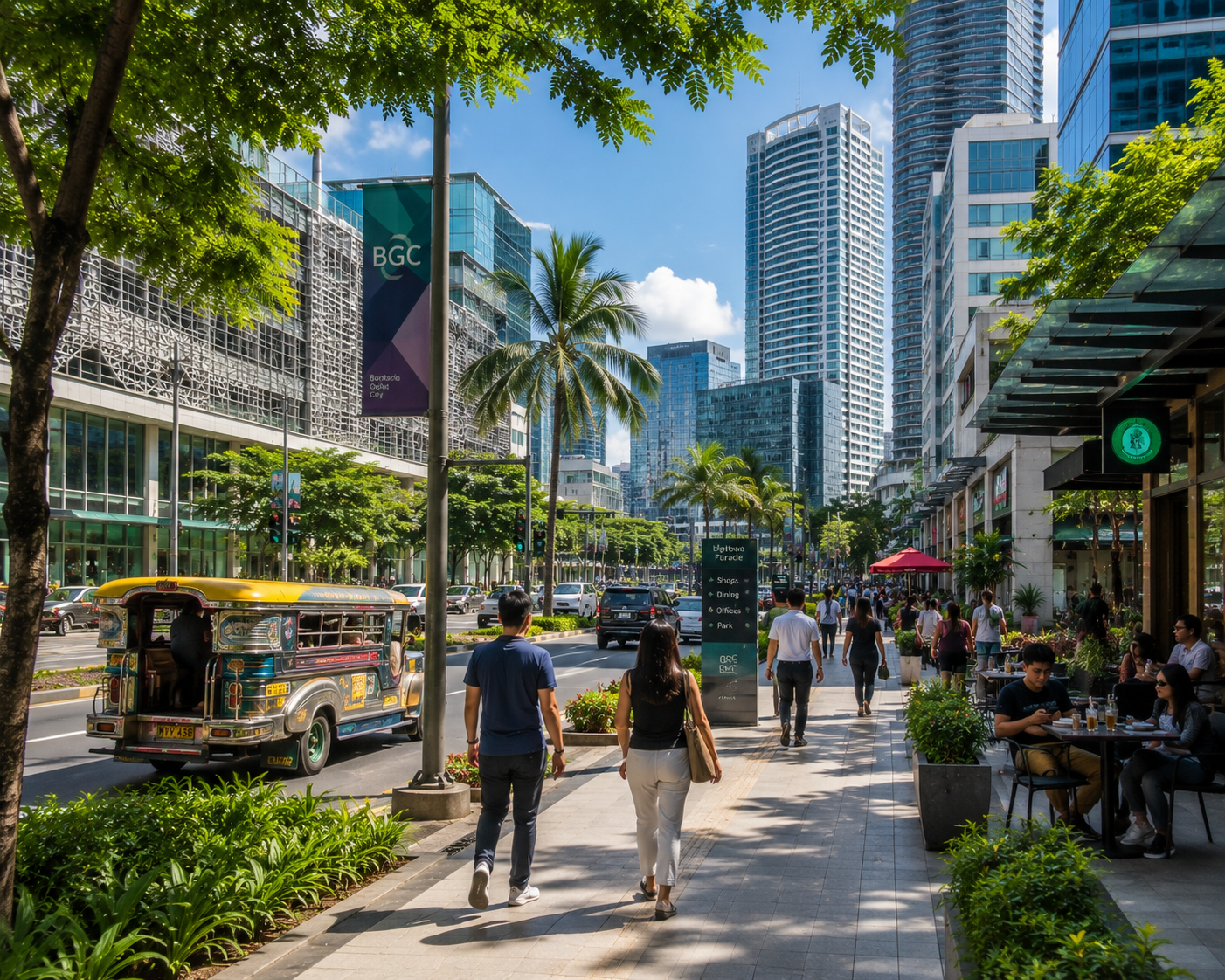
For retirees, Manila usually means a much narrower set of livable districts and urban centers such as Bonifacio Global City, Makati, Rockwell, Ortigas, Alabang, and selected Bay Area locations. These areas offer modern condominiums, private hospitals, international dining, shopping centers, English accessibility, and relatively strong security and convenience. The retirement experience in these districts is very different from the broader image of Metro Manila as chaotic and unmanageable.
Manila works best for retirees who want healthcare depth, English communication, large-city convenience, and a familiar urban lifestyle within the Philippines. It is not the best fit for retirees seeking quiet coastal living, low-density neighborhoods, or a slower emotional pace. The city can be stressful, but for retirees who choose the right district and keep daily life geographically compact, Manila can be one of the most practical and medically capable retirement bases in the region.
Quick Snapshot
Cost of Living: Moderate to high by Philippine standards, still affordable compared with major Western cities
Healthcare Quality: Strong private healthcare with some of the best hospitals in the Philippines
Lifestyle: Dense metropolitan living focused on modern districts, malls, dining, healthcare, and convenience
Climate: Tropical urban climate with heat, humidity, rainy seasons, and flooding risk in some areas
Expat Community: Large, established, and concentrated in specific districts
Best For: Healthcare-focused retirees, urban retirees, and English-speaking retirees seeking metropolitan convenience
Lifestyle and Environment
The key to understanding Manila as a retirement destination is that retirees rarely live “all of Manila.” They live inside specific districts, routines, buildings, and service networks. A retiree based in BGC, Rockwell, or a well-located part of Makati can experience a version of Manila that is modern, walkable in sections, service-rich, and highly convenient. That experience is completely different from trying to navigate the entire metro area every day.
This is why neighborhood choice matters more in Manila than in almost any other city on the list. In smaller cities, a retiree can often make a mediocre location work because distances are manageable. In Manila, a poor location choice can make daily life exhausting. A good location choice can make the city surprisingly livable.
The best retirement version of Manila is highly localized. Retirees who do well usually build their lives around a tight radius that includes their condominium, preferred restaurants, grocery stores, hospital access, cafés, gym, pharmacy, and social routines. This reduces exposure to the city’s worst traffic and makes Manila feel less like a chaotic megacity and more like a collection of controlled lifestyle zones.
Compared with Cebu, Manila offers deeper healthcare, more international dining, stronger shopping infrastructure, and a wider range of high-end residential options. Compared with Dumaguete, Manila is dramatically more intense, but also far more capable medically and commercially. Compared with Bangkok, Manila is less transportation-efficient but more linguistically accessible for English-speaking retirees.
The city is best understood as a practical metropolitan option, not a relaxing tropical escape. Its strengths are healthcare, communication, convenience, and service access. Its weaknesses are congestion, environmental stress, and the need to manage location carefully.
Cost of Living
Manila can be affordable or expensive depending heavily on district, housing choice, and lifestyle expectations. It is much more expensive than Dumaguete and generally more expensive than Cebu, but it remains more affordable than comparable major cities in the United States, Australia, Europe, Hong Kong, or Singapore.
Housing is the biggest variable. A retiree living in a premium condominium in BGC, Rockwell, or central Makati can spend significantly more than someone living in Ortigas, Alabang, or a less central district. The higher cost often buys real lifestyle advantages: better security, more reliable building maintenance, easier access to restaurants and shopping, stronger walkability, and proximity to healthcare.
Condominium living is especially common among foreign retirees because it simplifies many practical issues. Security, maintenance, amenities, elevators, backup power systems, and proximity to malls or business districts all matter more in Manila than they might in a smaller city. A good building can significantly reduce daily friction.
Food and dining are among Manila’s strongest advantages. The city offers extensive access to Filipino food, Western restaurants, Japanese dining, Korean food, Chinese cuisine, cafés, bakeries, imported groceries, wine shops, specialty products, and international retail. For retirees who want familiar products from home, Manila performs very well compared with most cities in the Philippines and many cities in Southeast Asia.
This matters over long retirement timelines. Many retirees initially focus on housing and healthcare, but after years abroad, familiar food, reliable restaurants, good grocery options, and easy access to ordinary comforts become psychologically important. Manila is strong in this area because it supports a highly international lifestyle without requiring retirees to leave the Philippines.
Utilities and internet quality vary by building and district. Premium residential towers often provide more reliable systems, while older or less well-managed buildings can create more frustration. As with most things in Manila, the quality of the micro-location and building matters enormously.
Healthcare
Healthcare is Manila’s strongest retirement advantage.
The city has the deepest private medical ecosystem in the Philippines and some of the strongest English-accessible healthcare in Southeast Asia. Major hospitals such as St. Luke’s Medical Center, Makati Medical Center, The Medical City, and Asian Hospital provide specialist care, diagnostics, surgery, emergency services, and long-term medical management at a level that smaller Philippine cities cannot match.
For retirees with chronic conditions, specialist needs, or age-related medical concerns, Manila can be far more practical than provincial retirement destinations. The ability to access major hospitals without flying to another city can become increasingly important over time.
Compared with Cebu, Manila offers greater specialist depth and a broader medical ecosystem. Compared with Dumaguete, the difference is even more significant. Many retirees who prefer provincial life still keep Manila in mind as the place they would go for major care.
Compared with Bangkok or Singapore, Manila may feel less polished in some aspects of hospital administration and infrastructure, but the English-speaking medical environment is a major advantage. For many Western retirees, being able to communicate clearly with doctors, nurses, billing staff, and specialists reduces stress during medical situations.
Healthcare is one of the main reasons Manila deserves serious consideration despite its urban frustrations. If medical access is a top priority, Manila is one of the strongest retirement bases in the Philippines.
Visa Options
The Philippines is generally one of the more accessible countries in Southeast Asia for long-term foreign retirees. The country has established retirement residency pathways, and English usage makes the process easier to understand than in many neighboring countries.
That does not mean administration is frictionless. Retirees should still expect paperwork, renewals, occasional inconsistency, and the need to follow procedures carefully. But compared with countries where language barriers create additional difficulty, the Philippines is relatively approachable.
For retirees who want to remain in an English-speaking environment with familiar legal and administrative communication, Manila has practical advantages. Legal services, immigration support, banking, insurance, and professional advice are easier to access in Manila than in most smaller Philippine retirement destinations.
Infrastructure and Accessibility
Manila’s infrastructure is both its greatest advantage and one of its greatest frustrations.
The city has enormous infrastructure depth: major hospitals, international airports, premium shopping centers, luxury residential towers, banking systems, restaurants, hotels, embassies, professional services, and entertainment districts. In terms of what is available, Manila offers far more than Cebu, Dumaguete, or most other Philippine cities.
The problem is access. Traffic can make distance feel much longer than it appears on a map. A trip that should be short can become stressful during peak hours or bad weather. Flooding can affect some areas during heavy rains. Infrastructure quality also varies widely depending on district.
This is why successful retirement in Manila usually requires a deliberate “small radius” strategy. Retirees should choose housing close to the services they actually use. Living near the right hospital, grocery store, restaurants, and social environment is not a luxury in Manila. It is a major quality-of-life decision.
Manila is not a city where retirees should casually assume they can move around easily every day. It works much better when life is designed around proximity.
Neighborhoods and Housing
Bonifacio Global City
BGC is one of the easiest districts in Manila for foreign retirees to understand and adapt to. It offers modern condominiums, wider streets, parks, cafés, restaurants, shopping, gyms, and a more organized urban environment than much of Metro Manila. For retirees who want Manila’s convenience with less chaos, BGC is often the first area to consider.
Makati
Makati remains one of Manila’s most established business and expat districts. It offers strong access to hospitals, restaurants, shopping, hotels, and high-rise housing. The lifestyle is highly urban, but for retirees who want central convenience and strong service infrastructure, Makati remains one of the most practical choices.
Rockwell
Rockwell offers a more contained and upscale residential environment. It is smaller, more controlled, and often feels more comfortable than broader Makati. Retirees who value security, walkability, and a more polished lifestyle may find Rockwell especially appealing.
Ortigas
Ortigas provides strong condominium infrastructure, shopping access, and business district convenience, often at somewhat lower costs than BGC or Rockwell. It can work well for retirees seeking urban convenience without the highest premium district pricing.
Alabang
Alabang appeals to retirees who want more space, greener surroundings, and a somewhat less intense atmosphere. It is farther from central Manila, but for retirees who prefer a suburban feel with access to hospitals, malls, and upscale residential areas, Alabang can be one of the most livable options.
Bay Area / Pasay
The Bay Area has grown rapidly with condominiums, malls, hotels, casinos, and entertainment infrastructure. It offers strong airport access and increasing convenience, but some retirees may find it more transient and commercially intense than BGC, Makati, or Alabang.
Transportation
Common Transportation Options
Most retirees in Manila rely on private cars, drivers, taxis, ride-hailing services, and walking within specific districts. Rail systems exist but are not comprehensive enough to define the retirement experience the way BTS and MRT systems do in Bangkok.
Transportation is one of Manila’s biggest quality-of-life issues. Retirees who need to cross the city frequently may quickly become frustrated. Retirees who keep most of life within one district can reduce that burden substantially.
In Manila, geography management is stress management. The right location can make the city livable. The wrong location can make even ordinary errands feel exhausting.
Safety
Safety in Manila is highly district-dependent. Premium retirement-friendly areas such as BGC, Rockwell, Makati, Alabang, and parts of Ortigas generally feel much more secure and manageable than the broader city image suggests.
Normal urban precautions still apply. Retirees should be aware of petty theft, scams, traffic safety, and personal security in crowded areas. However, many long-term foreign residents live comfortably in Manila by choosing appropriate neighborhoods and avoiding unnecessary exposure to higher-risk environments.
For many retirees, the bigger issue is not personal danger but urban stress. Traffic, noise, density, and uneven infrastructure can become tiring over time. This is another reason district selection matters so much.
Climate and Environment
Manila has a tropical urban climate with year-round heat, humidity, rainy seasons, and periodic typhoon exposure. The climate can feel more intense than in smaller coastal cities because of traffic, concrete density, pollution, and limited green space in many areas.
Compared with Dumaguete or Hoi An, Manila feels much more urban and physically demanding. Compared with Cebu, it generally feels denser and more congested. Compared with Bangkok, it can feel less infrastructure-buffered, especially during heavy rains or traffic disruptions.
Climate comfort depends heavily on lifestyle design. Retirees living in well-managed condominiums with good air-conditioning, backup systems, nearby malls, and easy access to services may experience the climate as manageable. Retirees who must travel long distances regularly may find the heat and humidity far more draining.
Manila is not a climate-driven retirement choice. It is a convenience, healthcare, and urban infrastructure choice.
Expat Community
Manila has a large and varied expat community, but it is not always as retirement-centered as places like Dumaguete, Hua Hin, or Pattaya. The foreign population includes retirees, businesspeople, diplomats, executives, long-term residents, and families.
This creates a broad but sometimes less intimate social environment. Retirees can find churches, clubs, restaurants, gyms, hobby groups, and social circles, but community may require more deliberate effort than in smaller retirement cities.
English accessibility makes social integration much easier than in many parts of Asia. Retirees can communicate easily with service providers, neighbors, medical professionals, and most commercial establishments. For many long-term residents, this reduces emotional fatigue and helps Manila feel more familiar than cities where daily communication requires constant translation.
Advantages of Retiring in Manila
Healthcare
Manila offers the strongest private healthcare ecosystem in the Philippines and is one of the best options in the region for English-accessible medical care.
English Accessibility
Daily communication is much easier than in many competing Asian retirement destinations.
Modern Convenience
Shopping, dining, banking, professional services, and condominium infrastructure are highly developed in the right districts.
District-Based Lifestyle
Retirees who choose carefully can build comfortable, localized routines in BGC, Makati, Rockwell, Ortigas, Alabang, or similar areas.
Challenges of Retiring in Manila
Traffic
Traffic is the single biggest practical frustration and must be managed through careful location choice.
Urban Stress
Noise, density, heat, and congestion can become emotionally tiring over time.
Infrastructure Variation
The difference between premium districts and broader Metro Manila can be substantial.
Climate
Heat, humidity, flooding risk, and urban pollution are important long-term considerations.
Who This City Is Best For
Strong Matches
- Healthcare-focused retirees
- Urban retirees
- English-speaking retirees
- Convenience-focused retirees
- Retirees comfortable with condominium living
Less Suitable Matches
- Low-stimulation retirees
- Beach-focused retirees
- Nature-oriented retirees
- Retirees seeking quiet provincial living
- Retirees highly sensitive to traffic and congestion
Comparison With Other Cities
Manila vs Cebu
Cebu offers a more manageable scale, stronger coastal feel, and lower daily intensity. Manila offers deeper healthcare, broader shopping and dining, stronger international infrastructure, and more premium urban options.
Manila vs Dumaguete
Dumaguete offers simplicity, affordability, and emotional calm. Manila offers medical depth, international convenience, and metropolitan lifestyle options.
Manila vs Bangkok
Bangkok has stronger mass transit, better urban organization, and more mature tourism infrastructure. Manila offers stronger English accessibility and a more familiar social environment for many Western retirees.
Manila vs Kuala Lumpur
Kuala Lumpur generally feels cleaner, calmer, and more infrastructure-refined. Manila offers broader English communication and stronger cultural familiarity for retirees who are comfortable with the Philippines.
Final Assessment
Manila is not the right retirement destination for someone seeking quiet, simplicity, or a soft landing into tropical leisure. It is too dense, too congested, and too operationally intense for that type of retiree.
But Manila becomes much more compelling when evaluated through the lens of its strongest districts rather than the entire metro area. A retiree living in BGC, Makati, Rockwell, Ortigas, Alabang, or another carefully chosen area can access excellent healthcare, strong English communication, modern condominiums, international dining, and highly developed shopping and service infrastructure.
The city’s success as a retirement destination depends on disciplined lifestyle design. Choose the wrong location, and Manila can feel exhausting. Choose the right district, building, and daily radius, and the city can become one of the most practical retirement bases in the Philippines.
For retirees who prioritize healthcare, English accessibility, urban convenience, and modern services, Manila remains one of Southeast Asia’s strongest metropolitan retirement options.
Find Your Best Retirement Destination
Use the retirement questionnaire to compare destinations based on your own retirement priorities, preferences, and long-term retirement goals.