
Bangkok, Thailand
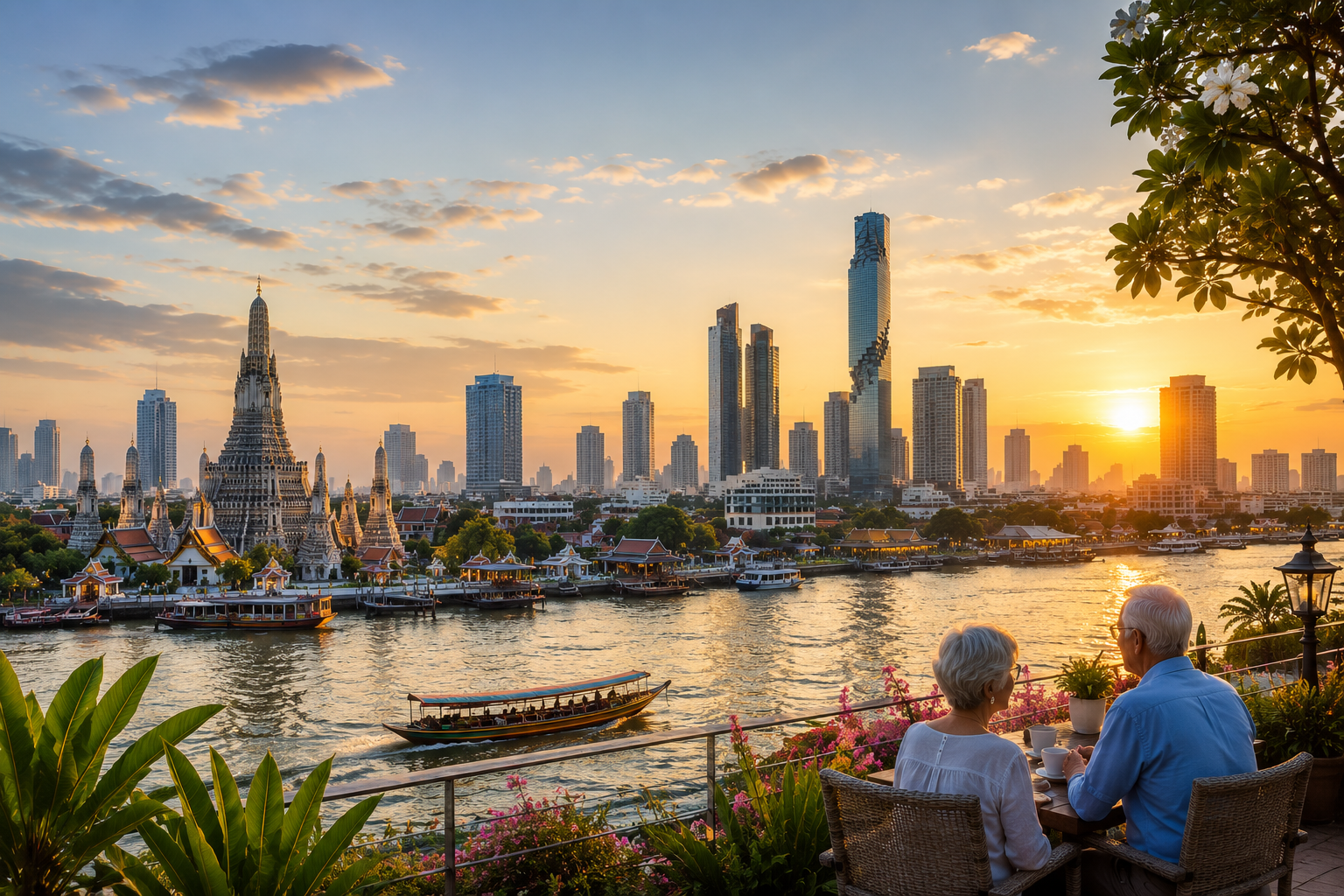
Retire in Bangkok at a Glance
Bangkok combines practical retirement costs, healthcare access, expat support, and a lifestyle profile suited to long-term retirement planning.
Best For
- Healthcare
- Excellent healthcare access
- Large expat community
- Long-term retirement living
Monthly Condo Rent
US$450-650
US$700-1100
US$1250-2000
Monthly Retirement Budget
US$1500-2000
US$2200-3000
US$3500-5000
Key Strengths
Healthcare: Excellent
Expat Community: Large
Best For: Healthcare
Confidence:
Bangkok is one of the most compelling and contradictory retirement cities in Asia. On one hand, it is crowded, humid, noisy, and intensely urban. On the other hand, it offers some of the best healthcare in the region, extraordinary food culture, highly developed infrastructure, and a level of convenience that many retirees eventually find difficult to leave behind once they adapt to it.
For retirees who genuinely enjoy metropolitan living, Bangkok can become an exceptionally rewarding long-term base. The city combines world-class private hospitals, extensive transportation systems, modern condominium living, international shopping, and extraordinary regional connectivity at costs that remain significantly lower than comparable global cities.
At first exposure, many retirees experience Bangkok as overwhelming. The city moves quickly, traffic can feel exhausting, and the climate can be physically draining. Yet over time, many long-term foreign residents stop experiencing Bangkok as one giant chaotic city and instead experience it as a network of highly livable neighborhoods connected by sophisticated transportation infrastructure. Once routines are established, daily life often becomes dramatically easier than outsiders initially expect.
One of Bangkok’s defining retirement realities is that the city becomes far more manageable once retirees learn how to structure their lives intelligently.
Bangkok works best for retirees who value healthcare access, infrastructure, dining and lifestyle variety, and a retirement environment that still feels active and stimulating rather than isolated.
It is not a retirement destination built around tranquility. It is built around convenience, healthcare, infrastructure, and metropolitan lifestyle access.
Quick Snapshot
Cost of Living: Moderate by Southeast Asian standards, affordable relative to major global cities
Healthcare Quality: Excellent, with internationally recognized private hospitals
Lifestyle: Fast-paced metropolitan living with exceptional convenience and infrastructure
Climate: Tropical urban climate with year-round heat and humidity
Expat Community: Large, mature, and highly international
Best For: Urban retirees, healthcare-focused retirees, and retirees seeking convenience and lifestyle variety
Lifestyle and Environment
Bangkok offers one of the most infrastructure-rich retirement lifestyles in Southeast Asia. Daily life revolves around transportation systems, shopping infrastructure, cafés, restaurants, condominium living, and highly developed commercial convenience networks that gradually become embedded into retirees’ routines over time.
For some retirees, this environment feels energizing and deeply engaging. For others, it eventually becomes emotionally exhausting. Bangkok is a city that rewards people who genuinely enjoy urban life and adapt well to constant activity, density, and sensory stimulation.
One of Bangkok’s strongest qualities is the sheer operational convenience available once retirees structure their lives strategically. A retiree living near BTS or MRT transportation lines can often avoid much of the city’s traffic, access hospitals quickly, have food delivered easily, and maintain a highly comfortable daily routine without needing a car.
That operational ease is one of Bangkok’s defining long-term strengths.
Compared with Manila, Bangkok generally feels more infrastructure-developed, more transportation-organized, and more internationally integrated. Compared with Kuala Lumpur, Bangkok feels more energetic, more intense, and more emotionally stimulating. Compared with Chiang Mai, Bangkok offers dramatically greater healthcare depth, shopping, transportation convenience, and lifestyle variety, though it sacrifices simplicity, calmness, and slower pacing.
Many retirees initially arrive in Bangkok expecting to stay temporarily before eventually relocating somewhere quieter. Surprisingly, a significant number remain for many years because they become deeply accustomed to the city’s convenience and flexibility.
Bangkok has a way of making daily life efficient once retirees learn how to navigate it.
Cost of Living
Bangkok remains relatively affordable considering the level of infrastructure and healthcare available. While prices have increased steadily over the past decade, the city still allows retirees to access high-quality housing, modern healthcare, international dining, and sophisticated transportation systems at costs far below most developed-world metropolitan areas.
The city works particularly well for retirees with moderate retirement budgets who prioritize convenience, healthcare access, and lifestyle infrastructure over ultra-low-cost living.
Housing options are extensive and highly varied. Retirees can choose between compact urban condominiums, luxury high-rise residences, serviced apartments, or quieter residential neighborhoods farther from the city center. Neighborhood selection matters enormously because different districts create very different retirement experiences.
Sukhumvit remains one of Bangkok’s most internationally integrated retirement areas because of its transportation access, shopping, international restaurants, and mature expat infrastructure. Thonglor and Ekkamai appeal more strongly to retirees seeking upscale urban lifestyles built around premium cafés, restaurants, nightlife, and modern condominium living. Ari has become increasingly popular among retirees who want a calmer and more neighborhood-oriented atmosphere while still maintaining excellent access to the city’s infrastructure.
Food is one of Bangkok’s greatest long-term strengths and one of the reasons many retirees remain emotionally attached to the city. Bangkok has one of the deepest dining ecosystems in Asia. Retirees can comfortably move between inexpensive local food, mid-range dining, and premium international restaurants with very little friction.
Over long retirement timelines, access to varied cuisine and imported groceries becomes far more important than many retirees initially realize. During the first few years abroad, adapting to local food often feels exciting and adventurous. But after many years overseas, many retirees begin placing increasing psychological value on familiar groceries, imported products, reliable Western dining, wines, cheeses, and broader dining variety.
Bangkok performs exceptionally well in this category compared with most retirement destinations in Southeast Asia.
Utilities are generally manageable, though electricity costs can rise substantially because of air-conditioning usage. Internet quality is strong, delivery systems are highly mature, and digital convenience infrastructure is among the best in the region.
Healthcare
Healthcare is one of Bangkok’s defining retirement strengths and one of the primary reasons many retirees remain in the city long term.
Thailand has developed one of Asia’s strongest private healthcare systems, and Bangkok sits at the center of it. Hospitals such as Bumrungrad International Hospital, Samitivej Sukhumvit Hospital, Bangkok Hospital, and MedPark Hospital are internationally respected and attract patients from around the world.
For many retirees, the healthcare experience in Bangkok feels highly modern, internationally standardized, and remarkably affordable compared with Western systems.
English-speaking medical staff are common in major hospitals, and many physicians have international training, Western certifications, or overseas medical experience.
One of Bangkok’s major retirement advantages is specialist depth. As retirees age, healthcare needs often become more complex, and access to advanced diagnostics and specialist networks becomes increasingly important. Bangkok performs exceptionally well in this area compared with most competing retirement destinations in Southeast Asia.
Compared with Malaysia, Bangkok’s healthcare quality is similarly respected, though Bangkok often feels larger-scale, more internationally visible, and more medical-tourism-oriented. Compared with Vietnam or the Philippines, Bangkok generally feels substantially more medically advanced and operationally reliable.
For retirees with ongoing medical concerns, chronic conditions, or long-term healthcare priorities, Bangkok remains one of the strongest retirement cities in Asia.
Visa Options
Thailand has long been one of the world’s best-known retirement destinations, and Bangkok benefits from the country’s mature foreign retiree ecosystem.
Thailand’s retirement visa pathways are relatively well established, though requirements and reporting obligations can occasionally feel bureaucratic. Even so, many retirees continue choosing Thailand because the overall lifestyle equation remains highly compelling.
Compared with Vietnam, long-term retirement structures in Thailand generally feel more mature and established. Compared with Malaysia, Thailand sometimes feels slightly less administratively predictable but often more lifestyle-oriented and emotionally engaging.
For many retirees, the practical frustrations of the visa system are outweighed by the city’s healthcare quality, food culture, infrastructure, convenience, and overall quality of life.
Infrastructure and Accessibility
Infrastructure is one of Bangkok’s defining strengths.
The BTS Skytrain and MRT systems fundamentally change the retirement experience in the city. Retirees who live strategically near rail systems often avoid much of Bangkok’s traffic congestion and dramatically simplify daily life.
Compared with Manila or Jakarta, Bangkok’s transportation systems feel significantly more mature, more usable, and more retirement-friendly.
Ride-hailing systems such as Grab are widely available, and delivery ecosystems are extremely efficient. Shopping infrastructure is extensive, hospitals are integrated into major urban districts, and international airport connectivity is among the best in Asia.
Suvarnabhumi Airport and Don Mueang Airport provide retirees with extraordinary regional and global access. For retirees who travel frequently, maintain family overseas, or enjoy regional exploration, Bangkok functions exceptionally well as a long-term operational base.
At the same time, Bangkok remains congested, humid, noisy, and physically intense. Retirees seeking tranquility, beach life, or emotionally slower environments may eventually find the city exhausting over very long periods.
Neighborhoods and Housing
Sukhumvit
Bangkok’s most internationally integrated retirement environment. Strong transportation access, shopping, dining, and expat infrastructure make it one of the city’s most practical long-term retirement districts.
Ari
More residential and calmer than central Sukhumvit. Popular among retirees seeking cafés, neighborhood atmosphere, and lower daily intensity while still maintaining strong city access.
Thonglor and Ekkamai
Upscale lifestyle-oriented districts known for premium restaurants, cafés, nightlife, and modern condominium developments.
Sathorn
Professional and infrastructure-oriented district with strong access to hospitals, transportation systems, and central business infrastructure.
Transportation
Bangkok’s transportation ecosystem includes BTS Skytrain lines, the MRT subway system, taxis, Grab ride-hailing services, buses, and motorbike taxis.
Most long-term retirees eventually structure their lives around rail access because it significantly reduces daily stress and transportation unpredictability.
Transportation access shapes quality of life far more than most retirees initially expect. For retirees who choose neighborhoods intelligently, Bangkok can become surprisingly manageable operationally despite its scale and intensity.
Unlike cities where retirement life depends heavily on private cars or improvised transportation, Bangkok gives retirees the option to build routines around fixed rail corridors, walkable commercial districts, medical access, and reliable ride-hailing. This does not eliminate traffic, but it allows retirees to reduce how much of the city’s congestion they actually experience.
Successful retirement in Bangkok is often less about mastering the entire city and more about choosing a district where daily needs are concentrated within a manageable radius.
Safety
Bangkok is generally viewed as manageable for long-term retirees using normal urban precautions.
Violent crime rates are relatively low by major global city standards, though retirees should remain aware of petty theft, tourist scams, and traffic-related risks.
One of Bangkok’s strongest safety advantages is that large portions of the city feel highly active, commercially integrated, and socially functional late into the evening. Compared with some metropolitan environments in Southeast Asia, Bangkok often feels relatively comfortable for long-term foreign residents.
The greater long-term challenge for many retirees is not safety itself, but managing the psychological fatigue that can come from prolonged exposure to density, congestion, noise, and constant urban activity.
Climate and Environment
Bangkok has a tropical urban climate characterized by year-round heat, humidity, monsoon rainfall, and dense urban heat accumulation.
The climate can feel physically exhausting for retirees unaccustomed to tropical megacities. However, Bangkok’s infrastructure helps moderate the experience through air-conditioned malls, transportation systems, cafés, restaurants, and modern condominium environments.
Compared with Kuala Lumpur, Bangkok generally feels hotter, denser, and more intense. Compared with Manila, Bangkok often feels somewhat cleaner, more transportation-organized, and less emotionally chaotic.
Bangkok is not a tropical retreat destination. It is a high-functioning tropical metropolis. Retirees who understand that distinction usually adapt far more successfully over time.
Long-term climate comfort in Bangkok often depends on lifestyle design. Retirees who insist on walking long distances outdoors during the hottest parts of the day may struggle. Those who build routines around early mornings, air-conditioned transit, shaded commercial districts, and well-located housing often find the climate more manageable than expected.
Expat Community
Bangkok has one of Asia’s largest and most diverse expat communities. Retirees can find churches, social clubs, fitness communities, hobby groups, and international social networks relatively easily.
At the same time, Bangkok can feel emotionally anonymous compared with smaller retirement destinations such as Hua Hin or Dumaguete.
Retirees who thrive there are usually those comfortable with independence, urban routines, and highly active lifestyles. Those who remain passive or isolated can sometimes experience loneliness, overstimulation, or emotional fatigue.
Bangkok rewards retirees who actively engage with the city rather than simply living inside it.
The expat community is large enough that retirees can usually find familiar networks, but it is not always as intimate or naturally cohesive as in smaller retirement cities. Social life often requires more initiative. Bangkok provides access, but it does not automatically provide belonging.
Advantages of Retiring in Bangkok
Healthcare
Bangkok has one of Asia’s strongest private healthcare ecosystems, with exceptional specialist depth and internationally respected hospitals.
Infrastructure
Transportation systems, airport connectivity, and commercial infrastructure are among the best in Southeast Asia.
Food Culture
Bangkok is one of the world’s great food cities, with extraordinary dining depth and variety across local, regional, and international cuisines.
Convenience
Bangkok offers an unusually high level of operational convenience once routines are established. Delivery systems, shopping access, healthcare availability, and transportation options make daily life easier than the city’s surface chaos initially suggests.
Challenges of Retiring in Bangkok
Climate
Heat and humidity are constant and can become exhausting over time, especially for retirees who prefer outdoor routines or cooler climates.
Traffic and Density
Congestion and sensory intensity are major long-term trade-offs. Even retirees who use rail systems effectively may still find the city physically and mentally demanding.
Urban Pace
Retirees seeking slower and quieter retirement environments may eventually struggle with Bangkok’s intensity.
Emotional Anonymity
Bangkok offers enormous access, but it can also feel impersonal. Retirees who want a small-town retirement atmosphere may find the city too large, too fast, or too socially diffuse.
Who This City Is Best For
Strong Matches
- Healthcare-focused retirees
- Urban retirees
- Internationally mobile retirees
- Food-oriented retirees
- Convenience-focused retirees
Less Suitable Matches
- Beach-focused retirees
- Nature-oriented retirees
- Slow-lifestyle retirees
- Retirees seeking emotional simplicity and low stimulation
Comparison With Other Cities
Bangkok vs Kuala Lumpur
Bangkok offers greater energy, food culture, nightlife, and urban stimulation. Kuala Lumpur generally feels calmer, cleaner, more spacious, and easier operationally.
For retirees who want healthcare, infrastructure, and modern convenience without Bangkok’s intensity, Kuala Lumpur may feel more sustainable. For retirees who want a city that feels more alive, more sensory, and more continuously engaging, Bangkok has a stronger emotional pull.
Bangkok vs Chiang Mai
Chiang Mai emphasizes slower living, affordability, cultural atmosphere, and emotional simplicity. Bangkok offers deeper healthcare, stronger infrastructure, greater transportation access, and dramatically greater lifestyle variety.
This is one of Thailand’s most important retirement contrasts. Chiang Mai may feel easier to live in emotionally, but Bangkok provides a far stronger safety net for retirees who prioritize healthcare, mobility, and urban convenience.
Bangkok vs Manila
Bangkok generally feels more transportation-developed, more internationally integrated, and more infrastructure-coordinated. Manila offers stronger English familiarity and Philippine cultural accessibility for many Western retirees.
For retirees who prioritize healthcare, transit, and urban organization, Bangkok is usually the stronger metropolitan retirement choice. For retirees who prioritize English-speaking daily life, family connections, or cultural familiarity with the Philippines, Manila may remain more comfortable.
Bangkok vs Penang
Penang offers a calmer, more compact retirement environment with strong healthcare and a mature expat community. Bangkok offers greater metropolitan depth, stronger transportation systems, broader dining variety, and far more urban energy.
Penang may be easier for retirees seeking balance and lower daily intensity. Bangkok is better suited to retirees who want large-city convenience and are comfortable with density.
Final Assessment
Bangkok is one of Asia’s strongest long-term metropolitan retirement environments.
Its defining strength is not tranquility. It is extraordinary convenience combined with world-class healthcare and urban infrastructure.
The city rewards retirees who adapt strategically, choose neighborhoods intelligently, and genuinely enjoy metropolitan living.
Bangkok is not the right match for retirees seeking quiet, simplicity, or a gentle small-city lifestyle. It is too dense, too hot, too active, and too stimulating for that. But for retirees who want strong hospitals, reliable infrastructure, exceptional food, regional travel access, and the convenience of a major Asian capital, Bangkok remains one of the most compelling retirement cities in Southeast Asia.
For retirees seeking healthcare confidence, infrastructure, lifestyle variety, international access, and highly active urban retirement living, Bangkok remains one of Southeast Asia’s most compelling long-term retirement destinations.
Find Your Best Retirement Destination
Use the retirement questionnaire to compare destinations based on your own retirement priorities, preferences, and long-term retirement goals.